

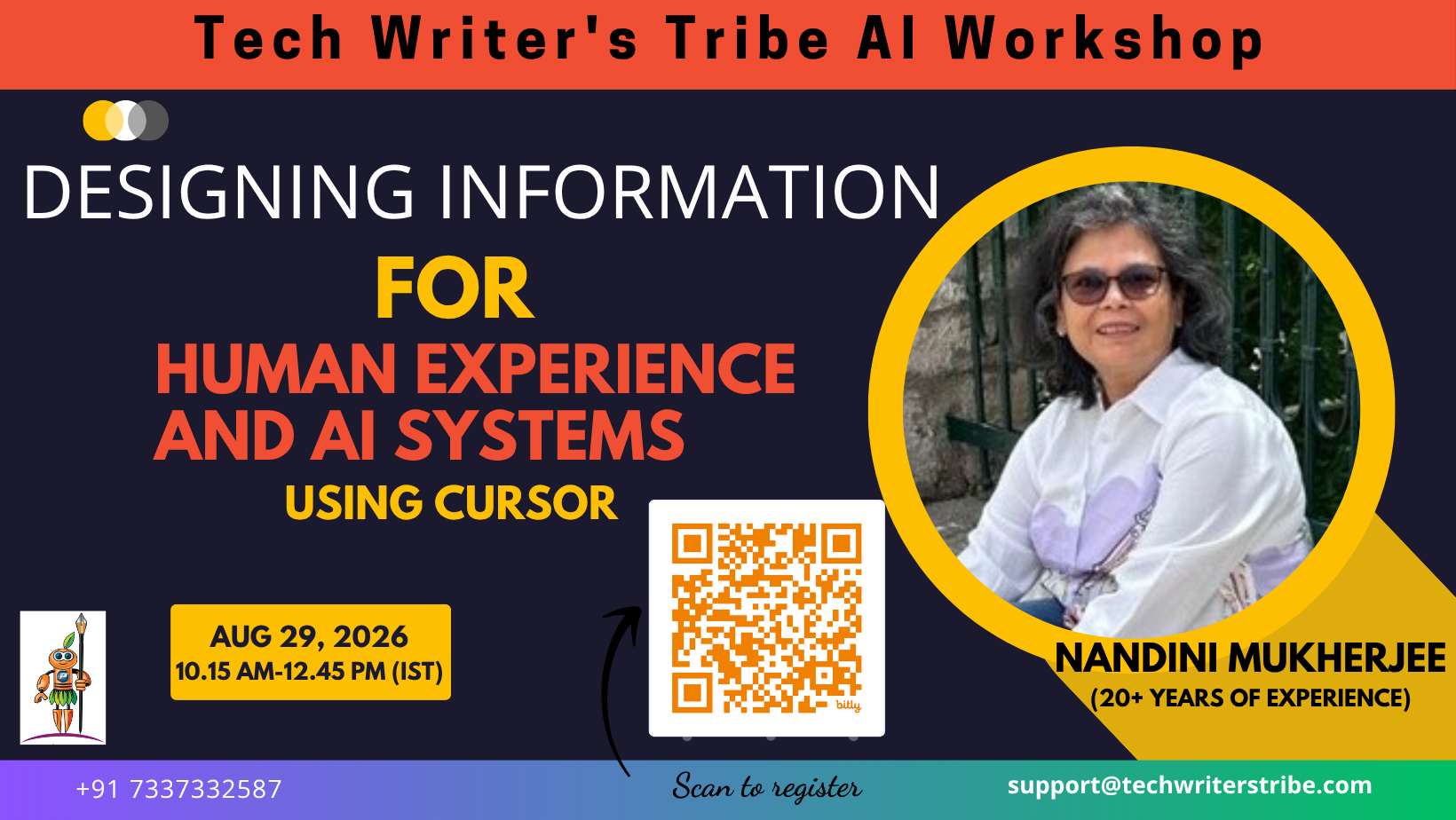
16 May Designing Information for Human Experience and AI Systems


Registration is Open for Batch 3 (August 29, 2026)
View Testimonials of Batch 1 (May 30) and Batch 2 (Jul 4) participants at the bottom of this page.
Designing Information for Human Experience and AI Systems
A 2.30-hour hands-on workshop for technical writers ready to create content that works for both human readers and AI systems — three live exercises, five practical modules, and frameworks you can use the very next day.
Starts in
Workshop details
Workshop Summary
Date
Saturday, August 29
Time
10:15AM – 12:45PM IST
Duration
150 mins total
Platform
Microsoft Teams
Format
60% instruction · 40% hands-on
Exercises
3 live activities + Q&A
Early Bird
$40/ ₹1,500 · First 10 seats
Regular Fee
$40 / ₹2,000
Install these two free tools before the session — you'll use them in the hands-on exercises.
Do not have Oxygen XML? Then, you need to be familiar with Markdown or any structured authoring tool.
What this workshop delivers
Learn it, practice it, leave with it
What you'll learn
- How AI interprets — and misinterprets — your content
- The dual-purpose writing framework for human readers and AI systems
- Retrieval-first design using atomic, modular topics
- How to integrate AI into your writing workflow without losing control
Who it's for
- Technical writers modernizing content for AI-powered environments
- Content strategists future-proofing their documentation systems
- Knowledge managers working with structured enterprise content
- Anyone using or evaluating AI in a writing or editing workflow
What you'll take away
- A rewritten, AI-ready content sample from your own material
- Dual-purpose writing template: contextual, structured, retrieval-friendly
- AI Failure Checklist and Atomic Content Checklist
- AI Workflow Blueprint: Generate → Validate → Structure → Refine → Govern
Workshop curriculum
Five modules · one intensive session
105 minutes of instruction and live exercises, followed by 15 minutes of open Q&A. Every module closes with a concrete, reusable takeaway.
Reframe how you think about your role and what your content actually produces.
Key concepts
- How AI is reshaping the way content is consumed and retrieved
- Readability vs. machine interpretability — the essential tension
- Content as a system, not a standalone artifact
- Content Maturity Model: Document → Structured Content → Information System
✏️ Activity · "Content Reality Check"
Evaluate a sample document as a group: Who is this written for? Can an AI extract meaning from it? Where would it fail? Leave with a gap analysis of your current writing approach.
📦 Takeaway
Writing is no longer the final output — it's structured input for multiple experiences.
Decode exactly how AI reads your content — and where it silently breaks down.
Key concepts
- Chunking, embeddings, and retrieval — a practical, non-academic view
- Why ambiguity and implicit context cause AI failures
- What actually triggers hallucination in AI-powered systems
✏️ Activity · "Break the AI"
Compare two versions of the same content — one written for humans, one structured for AI. Predict what the AI will extract and misinterpret, then see the actual outputs revealed live.
📦 Takeaway · AI Failure Checklist
Missing context · Implicit assumptions · Mixed intent · Unstructured flow
A practical framework for writing that humans can trust and AI systems can accurately retrieve and reuse.
Key concepts
- Context before instruction — why setup matters for both audiences
- Structured and semantic organization for clarity and AI indexing
- Consistency of language and terminology across a content system
- Improving AI retrieval readiness without harming readability
- Designing for trust and verification at every level
📦 Takeaway · Dual-Purpose Writing Template
Contextual · Structured · Consistent · Retrieval-friendly · Trustworthy
Shift from linear writing to retrieval-first content design — for search, AI answers, and reuse.
Key concepts
- Modular, self-contained, reusable topics — the atomic content unit
- Task-based structuring for AI-powered answers and search
- Designing headings, metadata, and tags for retrieval performance
✏️ Activity · "Chunk and Tag"
Break a document into atomic units, assign intent labels (task, concept, reference), rewrite headings for retrieval, and add metadata. Leave with a retrieval-ready content set.
📦 Takeaway · Atomic Content Checklist
One purpose per topic · Self-contained · Clearly labelled intent
Redesign your writing process to integrate AI effectively — without losing human oversight and quality control.
Key concepts
- AI as a collaborator — where it helps most and where you stay in control
- Human-in-the-loop validation: what to check and when
- Evaluating and improving AI-generated content before publishing
✏️ Group Exercise · "Redesign Your Workflow"
Map your current writing workflow. Identify where AI can assist and where human judgment is critical. Compare workflows across the group and extract shared best practices.
📦 Takeaway · AI Workflow Blueprint
Generate → Validate → Structure → Refine → Govern
Session closes with an open 15-minute Q&A — bring your toughest content challenges and get direct answers from the trainer.
Meet your trainer
About the instructor
Nandini Mukherjee
Information Experience Consultant · Synopsys Inc
Nandini is a seasoned leader with over 30 years of experience in technical communication, customer experience, and knowledge management. She has led global technical writing teams and driven the evolution from traditional documentation to dynamic, AI-powered knowledge experiences — the exact transformation this workshop is designed to teach.
Reserve your seat
Designing Information for Human Experience & AI Systems
Saturday, August 29, 2026 · 10:15 AM – 12:45 PM IST
Live online via Microsoft Teams · 150 minutes
Join July 4 Batch.
What Participants Say
Feedback from Batch 1 participants (May 30, 2026)
"It was a great session with well-structured information."
Srimathi R
Technical Writer, IBM"Very good and easily consumable course. It has clear takeaways that can help me implement them in my daily work."
Renny Abraham
Lead Technical Writer, OpenText"I got to learn many new things, and she answered my doubts."
Shalmoli
Technical Writer, Grant Thornton"Good hands-on experience along with real-life examples made the session stand out. I loved the practical ideas that I can take back to work."
Akash Jujam
Senior Information Developer, Precisely"I enjoyed this session and found it very insightful. The trainer provided deep and valuable insights that helped me gain new perspectives and a better understanding of AI. Overall, it was an engaging and enriching learning experience."
Namita Rathore
"Attending a workshop led by Nandini on a relevant topic helps me organize my thoughts, gain clarity and perspective, and leaves me energized to apply the key takeaways in my work. Thank you, Tech Writer's Tribe, for this workshop and a very relevant agenda."
Deepti Sawhney
Senior Technical Writer, Synopsys"The workshop provided valuable insights into how AI is transforming documentation practices. The trainer explained the concepts clearly, and it was an informative and engaging learning experience."
Divya DK
Senior Technical Writer, Cognizant"The trainer is very knowledgeable, and the hands-on exercises were quite engaging."
Sohini Chakraborty
Senior Technical Writer, Aurigo Software Technologies"I appreciate the focus on designing content that serves both human readers and AI systems. The examples and activities prepared by Nandini helped bridge the gap between traditional documentation practices and emerging AI-driven content strategies."
Anubhav Chaudhary
Junior Technical Writer, DDN"I found the validating accuracy and the documentation validation process very useful. I can start using them immediately."
Ramaa Rao
Sr Principal User Assistance Developer, Oracle"Knowledgeable and helped me understand the concepts."
Meghana
Technical Writer, Bengaluru"Great learning experience."
Sumit Batra
Lead Technical Writer, Siemens"Session is spot on for the Writers who values their work and evolve with current AI trend."
Sabarish Katta
Sr. Manager, Documentation, Mitratech"An example that showed how AI incorrectly infers the badly written document vs how it works with well written document is really good. Overall, the entire session was good."
Prashant Ahire
Senior Technical Writer, Pune"The session is very informative... Loved the session very much."
Sai Janani Kanike
Information Developer, Infor"It was very helpful and relatable workshop to understand and work along the current trend. The nuances discussed are genuinely comprehensible."
Soumiya D S
Technical Writer, Gigamon"The workshop conducted by Nandhini Mukherjee was highly insightful and well-structured. She delivered a thorough walkthrough on integrating documentation workflows with AI responses and leveraging AI to enhance workplace productivity. The session was rich in knowledge sharing and offered practical takeaways that directly support documentation efficiency."
Vaishnavi E
Staff Technical Writer, Gigamon"Well Explained"
Sorry, the comment form is closed at this time.