
24 Aug Career Journey in AI Era – Next Two Years


The Technical Writer's Career Journey in the AI Era
From technical writer to AI-native content professional — what beginners, experienced writers, and managers each need to learn over the next two years.
Artificial intelligence is changing technical writing. But the biggest change may not be that AI can write documentation — it's that AI is changing what organizations expect from the people who manage information.
For decades, technical writers built careers by getting better at writing, editing, information architecture, tools, and working with subject matter experts. Those skills still matter. But the path is expanding.
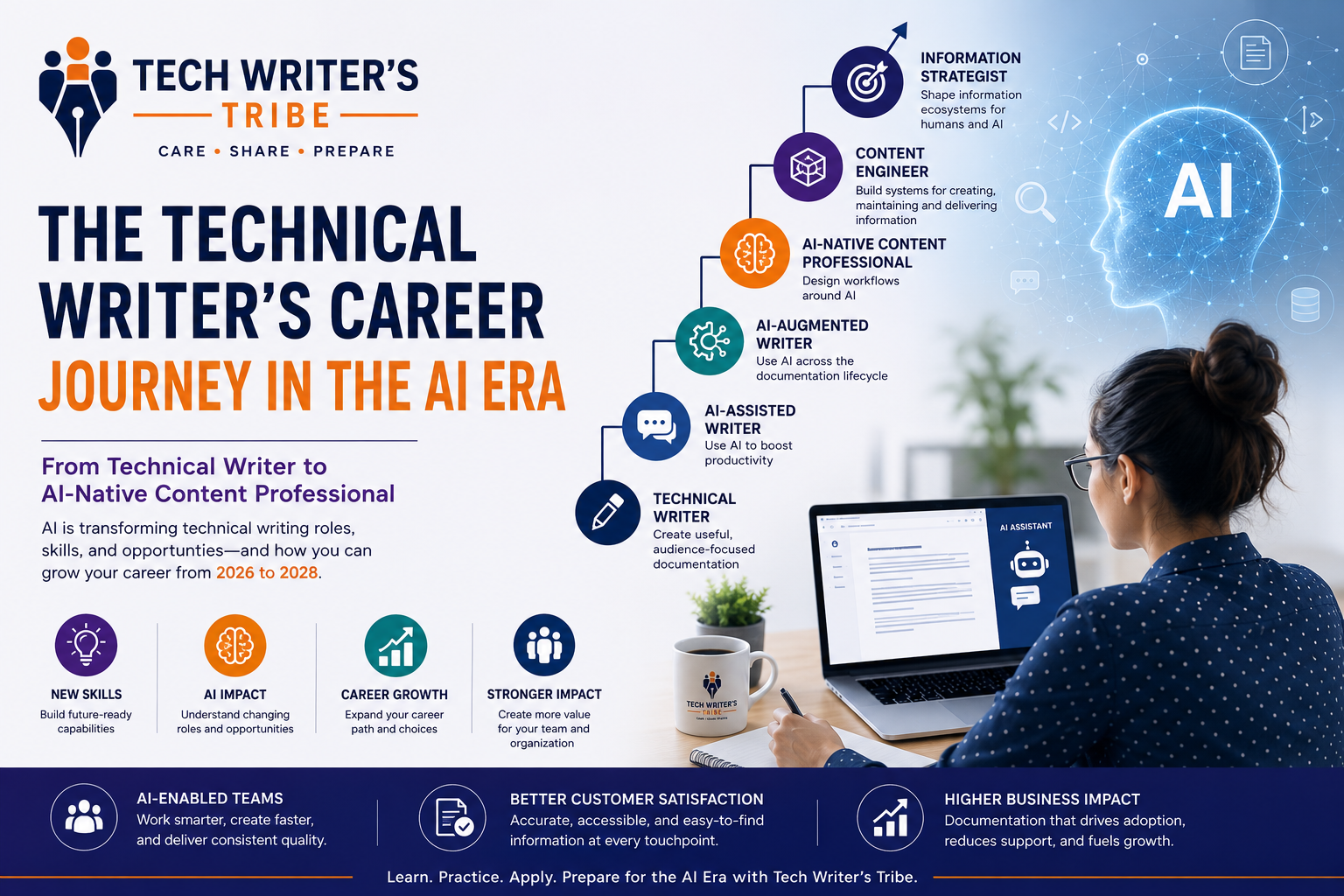
The career journey is no longer simply Junior → Writer → Senior → Lead → Manager. It is becoming Technical Writer → AI-Assisted Writer → AI-Augmented Writer → AI-Native Content Professional → Content Engineer → Information Strategist.
The question is no longer whether technical writers should learn AI. The question is: how much of the AI-enabled information ecosystem do you want to be capable of owning?
01Why the journey has changed
Before generative AI, a writer's productivity depended on personal writing skill, tools, templates, and organizational knowledge. AI adds a second track: learning to use AI, integrate it into workflows, automate processes, and design AI-enabled content systems.
This doesn't make traditional skills irrelevant — it makes them more valuable when paired with new capability. AI can generate an explanation; the technical writer still has to judge whether it's correct, complete, audience-appropriate, consistent, safe to publish, and actually useful.
02Five levels of the AI-era technical writer
The transition won't happen overnight, and not everyone needs to reach the same level — but these five stages map the direction of the profession.
The Foundation Writer
AI should not replace this learning. A beginner still needs technical writing principles, audience analysis, information architecture, task-based writing, API documentation, editing, and the documentation lifecycle. AI speeds up learning — but a beginner who leans on it before developing judgment risks learning to generate documentation without learning to recognize good documentation.
Goal: become a strong writer who uses AI responsiblyThe AI-Assisted Writer
AI becomes a productivity assistant for brainstorming, research, outlining, drafts, rewriting, terminology, examples, and readability. The writer stays the decision-maker. The real skill isn't prompting — it's knowing what to ask AI to do, what context to give it, and how to validate what comes back.
Goal: more productive, without sacrificing qualityThe AI-Augmented Writer
Instead of using AI only at the drafting stage, the writer applies it across requirements, content planning, SME prep, review against standards, release notes, and content reuse — often alongside Git, Docs-as-Code, APIs, and early AI agents. The role shifts from "I create documentation" to "I design the process that creates it."
Goal: redesign documentation workflows using AIThe AI-Native Writer
AI becomes part of the normal working environment: analyzing large repositories, building reusable AI workflows, automating documentation checks, working with RAG and AI agents, and exploring MCP and connected tools. This is the line between an AI user and an AI-enabled content professional.
Goal: design workflows around AI, not just use itContent Engineer & Information Strategist
Documentation has traditionally been designed for humans. Increasingly it's also consumed by search engines, LLMs, RAG systems, and AI agents. The question expands from "how do I write this?" to "how should this information be structured so the right human or AI system can find and use it?"
Goal: design information ecosystems for humans and AI"AI knowledge without documentation expertise" loses to "documentation fundamentals plus AI literacy" — every time.
03What each group should learn
Beginners
Resist the urge to learn every AI technology at once. Build the foundation first, then layer AI on top.
- Technical writing & information architecture
- Audience analysis
- Product & API documentation basics
- Markdown, Git/GitHub
- Agile documentation workflows
- AI fundamentals & prompting
- AI-assisted research
- Validating AI output
Experienced technical writers
The risk here is comfort with what already made you successful. The shift is from Author to Workflow Designer — from "how can AI help me write this?" to "how can AI improve the entire documentation lifecycle?" Then measure it: time saved, quality change, review effort, consistency, and maintenance load.
Technical writing managers
Managers aren't just telling writers to "start using AI" — they're rethinking how the team operates, across four questions:
- People — what skills will the team need two years out?
- Process — which activities can be AI-assisted or automated?
- Technology — which AI, automation, and knowledge tools are worth adopting?
- Governance — how do we keep AI-assisted content accurate, secure, and trustworthy?
04Will AI reduce technical writing jobs?
AI will change the tasks, expectations, and skill requirements tied to many technical writing roles — in three ways.
1. Some tasks get easier — first drafts, rewriting, summarization, basic editing, formatting, and simple maintenance checks all get faster, freeing time for judgment-heavy work.
2. Existing roles change — "create and maintain documentation" is becoming "create and maintain product information using AI-enabled workflows, automation, and structured content." Same job title, different capability bar.
3. New roles emerge — at the intersection of content, technology, information, and AI: Content Engineering, Knowledge Engineering, AI Content Strategy, Documentation Automation, and AI-enabled Documentation Leadership. The titles vary; the capability is what matters.
05The skills that will matter
| Skill | Beginner | Experienced TW | Manager | Future relevance |
|---|---|---|---|---|
| Technical writing | ★★★★★ | ★★★★ | ★★★ | Essential |
| Information architecture | ★★★ | ★★★★★ | ★★★★ | Very high |
| AI literacy | ★★★ | ★★★★★ | ★★★★★ | Very high |
| Prompting | ★★★ | ★★★★ | ★★★ | High |
| Docs-as-Code | ★★★ | ★★★★★ | ★★★ | High |
| Automation | ★★ | ★★★★★ | ★★★★ | Very high |
| Structured content | ★★ | ★★★★★ | ★★★★ | Very high |
| RAG / knowledge systems | ★ | ★★★★ | ★★★★ | Emerging/high |
| AI agents | ★ | ★★★★ | ★★★★ | Emerging |
| AI governance | ★ | ★★★ | ★★★★★ | Very high |
| Business metrics | ★ | ★★★ | ★★★★★ | Very high |
06The 2026–2028 learning roadmap
Learn to work with AI
Write + prompt + validate + automate. Almost everyone will have access to AI tools — the differentiator is integrating AI effectively into real documentation work.
Learn to build around AI
Content + data + knowledge + AI + automation. Writers fluent in structured content, RAG, agents, and content architecture move beyond conventional documentation.
07Where are you in your AI journey?
A quick self-check — count how many of these you can honestly say yes to:
0–3: Foundation Stage · 4–6: AI-Assisted Writer · 7–9: AI-Augmented / AI-Native · 10–12: Content Engineering / Information Strategy. This isn't a test — it's a way to ask what to learn next.
08The new career development model
Every technical writer doesn't need to reach Content Engineer. Career development isn't a single ladder anymore — it's a landscape with multiple paths, and a healthy team will have people strong in product documentation, AI-assisted workflows, automation, information architecture, knowledge systems, and strategy all at once.
09The opportunity
It's easy to focus on what AI automates. The better question is what becomes possible when writers are freed from repetitive work: more time with products, closer work with engineering, better information architecture, better workflows, and a real seat in making information accessible to both humans and AI. The profession doesn't have to get smaller — it can get broader and more strategic.
Care. Share. Prepare. The best time to start building these skills isn't when the transformation is complete — it's now.
Build your AI-era skill stack with a 25,000+ member community
Courses, certifications, mentorship, and workshops covering AI-assisted documentation, Docs-as-Code, DITA, and API documentation — built by and for technical writers.
Explore Courses & Membership →
Sorry, the comment form is closed at this time.