
26 Aug Growing Impact of Docs as Code in the AI Era and 2026


The AI-Era Career Leap: Why Technical Writers Must Shift to Docs-as-Code
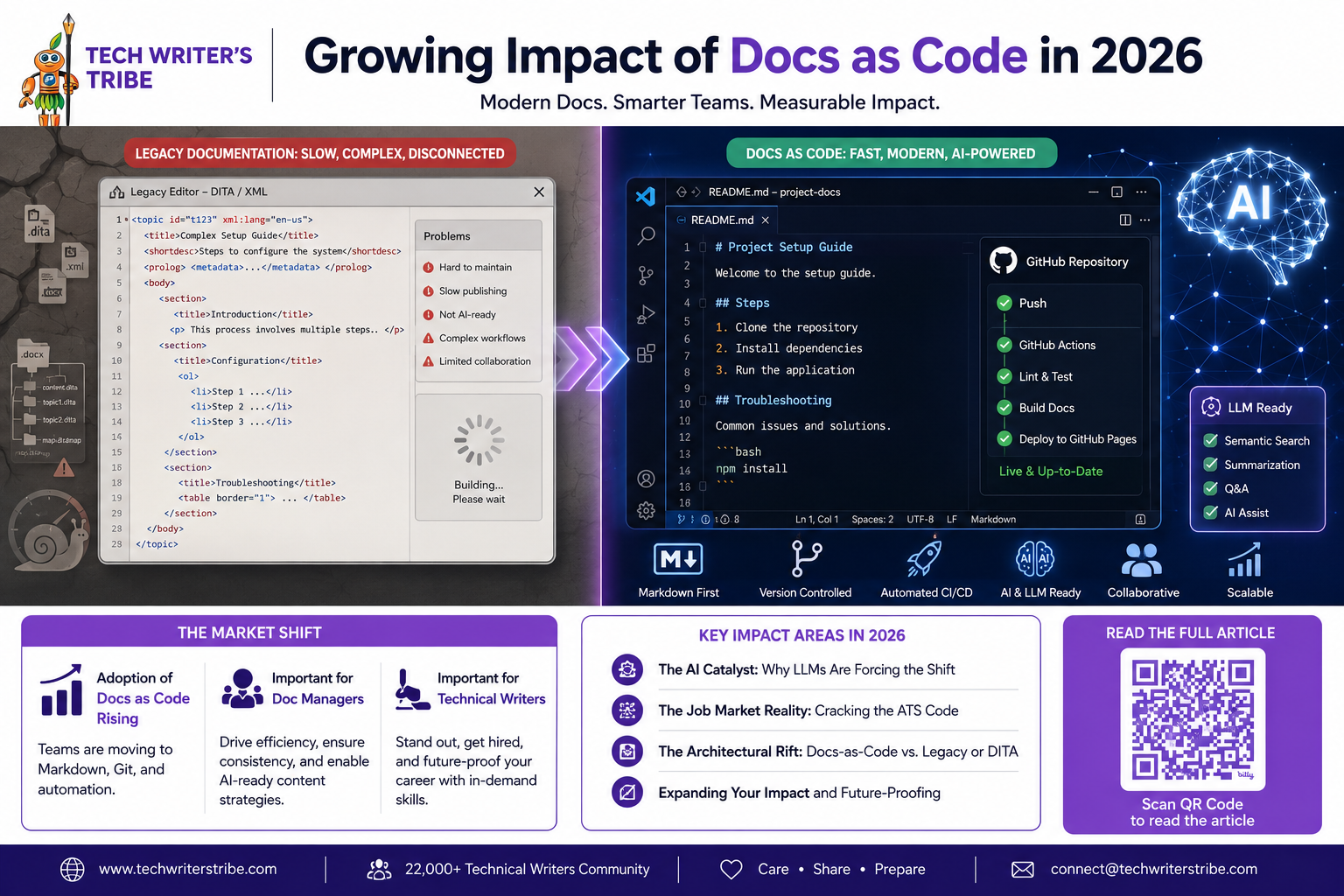
The field of technical communication is experiencing a major transformation. For years, heavy structured frameworks like DITA (Darwin Information Typing Architecture) were the standard for managing complex corporate documents. But today, engineering speeds, agile product cycles, and the rise of Artificial Intelligence (AI) have exposed deep flaws in these traditional, closed tools.
Modern documentation leaders and technical writers are dropping old-school XML editors. Instead, they are moving toward Docs-as-Code—a strategy that treats text files like software code, utilizing the exact same tools and pipelines as developers.
🧠 1. The AI Catalyst: Why LLMs Are Forcing the Shift
The explosion of Large Language Models (LLMs) and Retrieval-Augmented Generation (RAG) backend systems has permanently broken static, closed documentation silos. AI systems require an open, agile documentation engine to function effectively:
- The Token Economy: AI models natively prefer clean text formats like Markdown (
.md) because they drastically optimize token consumption and minimize parsing errors during data ingestion. - Real-Time Context for Chatbots: Modern technical documentation is no longer just consumed on web pages; it feeds conversational AI interfaces. A Git-powered Docs-as-Code pipeline allows RAG systems to instantly crawl documentation changes alongside software code, preventing the AI from "hallucinating" outdated data.
- AI-Assisted CI/CD Validation: By treating docs as code, you can inject AI automated review bots straight into your GitHub or GitLab Pull Requests to screen text style, clarity, and typos before human review.
📋 2. The Job Market Reality: Cracking the ATS Code
Hiring practices in the technology sector have aggressively shifted from tracking general headcount to filtering for high-value technical skill sets.
- The JD Mandate: For core engineering, developer portal, and enterprise B2B SaaS positions, over 60% of technical writing job descriptions now specify automated pipeline or Git-based repository experience.
- Beating the ATS Gatekeepers: Modern Applicant Tracking Systems (ATS) actively screen out traditional technical writers by checking for specific operational keywords. If your resume lacks terms like
Git,Markdown,Pull Requests,CI/CD Pipelines, andStatic Site Generators (SSGs), you risk automatic rejection before a human recruiter ever sees your portfolio. - The Financial Premium: Technical communicators who possess the automation engineering and architecture skills required to run a Docs-as-Code pipeline command significantly higher salaries because they solve complex workflow problems rather than just processing standalone text drafts.
🔄 3. The Architectural Rift: Docs-as-Code vs. Legacy DITA
While DITA was built for rigid reuse in industrial settings, Docs-as-Code is built for human collaboration, speed, and continuous software cycles.
| Evaluation Criteria | Legacy / DITA Systems | Modern Docs-as-Code |
|---|---|---|
| SME Collaboration | High friction; engineers refuse to leave their IDEs to log into complex XML CCMS interfaces. | Zero friction; developers co-author and review directly via standard Markdown files in their existing IDEs. |
| Cost Efficiency | Expensive per-seat enterprise license models that restrict document updates to a tiny pool of licensed authors. | Open-source foundation (Git, Docusaurus) that allows you to scale to hundreds of contributors with no added cost. |
| Release Agility | Detached publishing cycles that cause late-stage bottleneck delays right at code release windows. | Automated, parallel integration testing that guarantees documentation launches the exact second code updates go live. |
📈 4. Expanding Your Impact and Future-Proofing
Staying comfortable with closed, legacy writing tools isolates the technical writer from the product ecosystem. Moving your documentation strategy into a Docs-as-Code structure changes your entire position within your organization:
- Moving Up the Value Chain: You graduate from a simple "draft processor" to an internal Information Architect and Automation Engineer who actively maintains the company's automated content distribution system.
- Earning Engineering Trust: Operating in the exact same environments (like Visual Studio Code and GitHub repositories) allows you to speak the same operational language as your engineering team, cementing your authority as a critical product stakeholder.
- Total Career Insurance: As AI continues to automate basic text generation, your ability to manage infrastructure, curate context windows, and architect data loops guarantees your job security in an increasingly automated tech world.
🎯 Ready to Future-Proof Your Technical Writing Career?
Ready to move past legacy word processors and command top-tier opportunities in the software and AI industries? Stop watching from the sidelines and learn the toolchain driving modern technical communication.
The Tech Writer's Tribe Training Academy is launching its live online cohort: Docs-as-Code with Docusaurus. Under the guidance of industry leader Punit Shrivastava, this hands-on, 12-hour practical course takes you from your very first plain-text Markdown file all the way to an automated publishing engine using Git, GitHub Actions, and Docusaurus. No development experience required.
👉 Secure your seat today and master the future of technical communication!
Sorry, the comment form is closed at this time.